
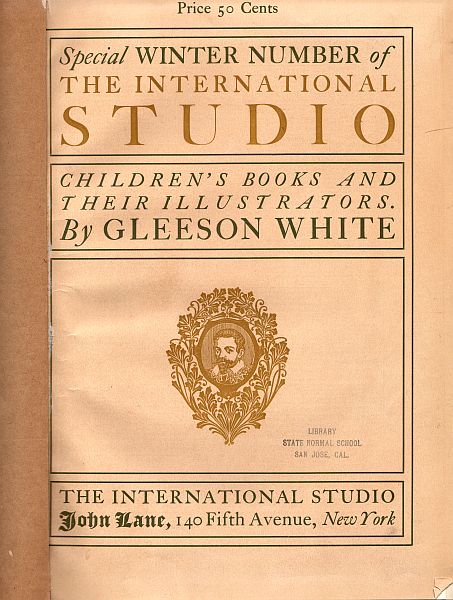
Gleeson White è stato uno scrittore d’arte inglese. A New York dal 1890 ha diretto per un paio d’anni la rivista Art Amateur (1891-92), per poi ritornare in Inghilterra, dove assume l’incarico di direttore editoriale di The International Studio, fondato da Charles Holme nel 1893. Due anni dopo, Holme stesso prende il posto di editor, anche se Gleeson White, per il resto della sua vita, continuerà a fornire contributi. White si dedica allo scrivere d’arte e fra i suoi libri che riscuotono maggiore successo è questo sui “Libri dei bambini e i loro illustratori”, pubblicato in un numero speciale della rivista The International Studio con la quale continua a collaborare. Come spiega lo stesso autore nelle pagine introduttive, White prende spunto dall’editoria contemporanea sull’argomento specifico dell’evoluzione del libro per l’infanzia. Il suo interesse è nato per caso, sfogliando un “volume ammirevole” che affronta il tema a partire dai tempi precedenti alla conquista normanna fino ai suoi stessi anni. Il libro in questione è intitolato “Il bambino e il suo libro”, di Mrs. EM Field, progettato per scopi didattici, come molti dei manuali legati alla letteratura destinata a impressionare con racconti fantastici. White evidenzia, però, che la sua iniziale curiosità è stata attratta da un eccellente capitolo riguardante “Alcuni illustratori di libri per bambini”. Ecco quindi l’idea del suo progetto editoriale, lo scopo principale che desidera raggiungere: non parlare dei contenuti letterari dei libri, ma concentrarsi sulle illustrazioni. A suo avviso, infatti, i nove decimi dei buoni libri illustrati sono dovuti al miglioramento apportato dall’artista e dall’editore, anche se è ovvio che le illustrazioni implicano qualcosa da illustrare e, di norma, migliore è il testo e migliori sono le immagini che ne scaturiscono. Basti fare l’esempio di bravissimi autori per bambini, come Charles Kingsley o Lewis Carroll, che forniscono il testo giusto per spronare l’artista a ottenere i suoi migliori risultati. In effetti, anche se potrebbe risultare impopolare progettare un libro come quello pensato e realizzato, ci si deve rendere conto, asserisce White, che il vero potere educativo del libro illustrato è sugli adulti, più che sui bambini, poiché aiuterà a elevare lo standard del gusto domestico nei riguardi dell’arte.
PUOI SCARICARE IL LIBRO O LE SINGOLE IMMAGINI DAL WEBSITE DEL PROGETTO GUTEMBERG: Children’s Books and Their Illustrators, by Gleeson White
[ms_row]
[ms_column style=”1/3″]
JOSEPH WILLIAM GLEESON WHITE (Christchurch 1851–1898), often known as Gleeson White, was an English writer on art. He was educated at Christ Church School and afterward became a member of the Art Workers Guild. He moved to New York City in 1890 where he conducted the Art Amateur (1891–92). He returned to England in 1893. He was the first serving editor of The Studio, founded by Charles Holme in 1893 (Lewis Hind had acted as editor for four months before the launch of the magazine). In 1895 Holme took over as editor himself, although Gleeson White continued to contribute for the rest of his life. He also edited during his last years the “Ex Libris Series”; the “Connoisseur Series”; the “Pageant”; and, with Edward F. Strange, Bell’s “Cathedral Series.” (Da Wikipedia, l’enciclopedia libera).
[/ms_column]
[ms_column style=”2/3″]
[ms_flip_box direction=”vertical” front_paddings=”25px 15px” front_background=”#eee” front_color=”” back_paddings=”15px” back_background=”#ede992″ back_color=”” class=”” id=””][ms_featurebox style=”1″ title_font_size=”18px” title_color=”#ff0000″ icon_circle=”yes” icon_size=”24px” title=”THE INTERNATIONAL STUDIO” icon=”fa-desktop” alignment=”left” icon_animation_type=”” icon_color=”#fff” icon_background_color=”#222″ icon_border_color=”” icon_border_width=”” flip_icon=”none” spinning_icon=”no” icon_image=”” icon_image_width=”” icon_image_height=”” link_url=”” link_target=”_blank” link_text=”” link_color=”” content_color=”” content_box_background_color=”” class=”” id=””]
Children’s Books and Their Illustrators
[/ms_featurebox]|||[ms_featurebox style=”1″ title_font_size=”18px” title_color=”#ff0000″ icon_circle=”no” icon_size=”46px” title=” LIBRO DI GLEESON WHITE” icon=”” alignment=”left” icon_animation_type=”” icon_color=”” icon_background_color=”” icon_border_color=”” icon_border_width=”” flip_icon=”none” spinning_icon=”no” icon_image=”” icon_image_width=”” icon_image_height=”” link_url=”” link_target=”_blank” link_text=”” link_color=”” content_color=”#fff” content_box_background_color=”” class=”” id=””] There are some themes that by their very wealth of suggestion appal the most ready writer. The emotions which they arouse, the mass of pleasant anecdote they recall, the ghosts of far-off delights they summon, are either too obvious to be worth the trouble of description or too evanescent to be expressed in dull prose. Swift, we are told (perhaps a little too frequently), could write beautifully of a broomstick; which may strike a common person as a marvel of dexterity. After a while, the journalist is apt to find that it is the perfect theme which proves to be the hardest to treat adequately. Clothe a broomstick with fancies, even of the flimsiest tissue paper, and you get something more or less like a fairy-king’s sceptre; but take the Pompadour’s fan, or the haunting effect of twilight over the meadows, and all you can do in words seems but to hide its original beauties.
>>>LEGGI IL LIBRO O AMMIRA LE INCISIONI<<< [/ms_featurebox][/ms_flip_box]
[/ms_column]
[/ms_row]

